Medicaid vs. Medicare: Key Differences Explained
Updated August 2026
Medicaid vs. Medicare is one of the most common points of confusion in U.S. health coverage. Both are government health programs and share some beneficiaries, but they're built on different legal foundations, serve different populations, and cover services in meaningfully different ways.
Side-by-side comparison of Medicaid and Medicare
Medicare is federal health insurance administered entirely by the federal government, primarily for people age 65 and older and certain individuals under 65 with disabilities or specific conditions like end-stage renal disease. Medicaid is a joint federal-state program — the federal government sets minimum standards through the Social Security Act and regulations like 42 CFR Part 435, but each state administers its own program with its own name, eligibility rules, and benefit package. About 12 million Americans are enrolled in both programs simultaneously — a group called "dual eligibles."
The table below outlines the core structural differences between the two programs.
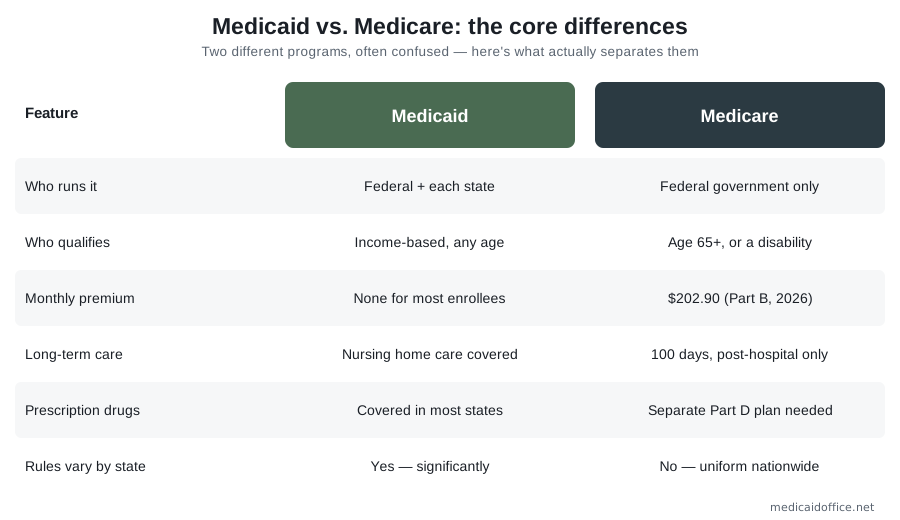
| Feature | Medicaid | Medicare |
|---|---|---|
| Who administers it | Federal government + each state | Federal government (CMS) |
| Who qualifies | Low-income individuals, families, elderly, disabled | Age 65+; certain people under 65 with disabilities or ESRD |
| Income requirement | Yes — income and sometimes asset limits | No income requirement to enroll |
| Premium cost | None for most enrollees | Part B premium ($202.90/month in 2026 for most) |
| Long-term care | Covers nursing facility care; HCBS waivers available | Limited — only short-term skilled nursing after hospital stay |
| Prescription drugs | Covered by Medicaid in most states | Part D (separate plan required) |
| Dental care | Mandatory for children (EPSDT); varies by state for adults | Not covered under Original Medicare |
| Eligibility varies by state | Yes — significantly | No — uniform nationally |
Who administers it
- Medicaid
- Federal government + each state
- Medicare
- Federal government (CMS)
Who qualifies
- Medicaid
- Low-income individuals, families, elderly, disabled
- Medicare
- Age 65+; certain people under 65 with disabilities or ESRD
Income requirement
- Medicaid
- Yes — income and sometimes asset limits
- Medicare
- No income requirement to enroll
Premium cost
- Medicaid
- None for most enrollees
- Medicare
- Part B premium ($202.90/month in 2026 for most)
Long-term care
- Medicaid
- Covers nursing facility care; HCBS waivers available
- Medicare
- Limited — only short-term skilled nursing after hospital stay
Prescription drugs
- Medicaid
- Covered by Medicaid in most states
- Medicare
- Part D (separate plan required)
Dental care
- Medicaid
- Mandatory for children (EPSDT); varies by state for adults
- Medicare
- Not covered under Original Medicare
Eligibility varies by state
- Medicaid
- Yes — significantly
- Medicare
- No — uniform nationally
One point worth emphasizing: Medicare eligibility has nothing to do with income. A retired CEO and a retired janitor both qualify at age 65. Medicaid eligibility is entirely based on financial need, category of eligibility, and the rules of the specific state where you live.
Who qualifies for each program
Medicare eligibility is defined federally and applies identically across all 50 states. You qualify if you are 65 or older and have worked (or your spouse has worked) at least 10 years paying Medicare taxes. People under 65 can qualify if they have received Social Security Disability Insurance (SSDI) for 24 months, have amyotrophic lateral sclerosis (ALS), or have end-stage renal disease requiring dialysis or a kidney transplant.
Medicaid eligibility is far more variable. In states that expanded Medicaid under the Affordable Care Act, most adults under 65 with household income at or below 138% of the Federal Poverty Level (FPL) qualify regardless of other factors. In non-expansion states, adults without children often do not qualify at all, no matter how low their income — per KFF analysis as of 2026, 10 states have still not adopted the ACA Medicaid expansion.
Beyond the expansion population, Medicaid also covers several distinct eligibility groups with different income and asset rules:
- Children up to at least 100% FPL in every state (most states cover significantly higher)
- Pregnant women — typically 138%–200% FPL depending on state
- Elderly individuals (age 65+) — often subject to asset tests in addition to income limits
- People with disabilities who receive SSI
- Foster care youth up to age 26 in most states
- Certain immigrants who meet categorical and income requirements
The phrase "low-income" understates how narrow Medicaid can be in some states. A single adult earning $15,000 per year in a non-expansion state may have no path to Medicaid coverage at all. That same person in an expansion state would qualify. This state-by-state variation is a defining feature of Medicaid eligibility that Medicare does not share.
What Medicare covers — and what it misses
Original Medicare has four distinct parts. Part A covers inpatient hospital care, skilled nursing facility care (short-term only), hospice, and some home health services. Part B covers outpatient care, physician services, preventive care, and durable medical equipment. Part C (Medicare Advantage) bundles Parts A and B through private insurers and usually includes Part D drug coverage. Part D covers prescription drugs through standalone private plans.
Medicare does not cover dental care under original Parts A or B. No routine vision. No hearing aids. Long-term nursing home care is the most consequential gap: Medicare covers skilled nursing facility care only for up to 100 days following a qualifying hospital stay of at least 3 days — and only while a patient is making measurable medical progress. Custodial care (help with bathing, dressing, eating) is not covered at all by Medicare.
This long-term care gap is why many people eventually spend down their assets to qualify for Medicaid, even after decades of Medicare enrollment. A private nursing home room costs a median of about $129,600 per year, per Genworth's most recent Cost of Care survey — Medicare was never designed to cover it.
How dual eligibility works
Approximately 12 million people — often called "dual eligibles" or "dually eligible beneficiaries" — are enrolled in both Medicare and Medicaid at the same time. This is legal, common, and in most cases highly beneficial to the enrollee.
When a dual-eligible person receives a Medicare-covered service, Medicare pays first. Medicaid pays last — picking up deductibles, coinsurance, and copayments that Medicare leaves behind. Per medicare.gov, if a person qualifies for full-benefit Medicaid, the state will pay their Medicare Part B monthly premium. Depending on the level of Medicaid coverage, the state may also cover Part A premiums, deductibles, and all cost-sharing.
Dual eligibles also automatically qualify for Extra Help (also called the Low Income Subsidy) with Part D prescription drug costs — a subsidy that can be worth thousands of dollars per year in reduced drug costs.
A hypothetical example: Maria is 68 years old, on Medicare, and has a monthly income of $1,100 — below 100% FPL. She qualifies for both Medicare and full-benefit Medicaid. Medicare covers her hospitalizations and doctor visits; Medicaid pays her Part B premium ($202.90/month in 2026), eliminates her Medicare deductibles, and covers nursing home care if she ever needs it.
Dual-eligible individuals have special enrollment options not available to other Medicare beneficiaries. Special Needs Plans (D-SNPs) designed for this population are available in most states. In certain states, Medicare-Medicaid Plans coordinate both programs under a single managed care contract. PACE (Program of All-Inclusive Care for the Elderly) is available in some states for those who meet nursing home level of care but want to remain in the community.
Medicare Savings Programs: Medicaid help for Medicare costs
Medicare Savings Programs (MSPs) are a category of Medicaid benefit specifically designed to help low-income Medicare enrollees pay Medicare's premiums, deductibles, and cost-sharing. Many people who qualify have never heard of them. Per KFF's analysis of 2026 Medicaid eligibility levels, there are three primary MSP categories:
| Program | Who qualifies | What it covers |
|---|---|---|
| Qualified Medicare Beneficiaries (QMB) | Income up to 100% FPL ($1,350/month for an individual in 2026) | Part A and Part B premiums plus all Medicare deductibles, coinsurance, and copayments. Providers are prohibited from billing QMB enrollees for Medicare cost-sharing. |
| Specified Low-Income Medicare Beneficiaries (SLMB) | Income up to $1,616/month for an individual in 2026 | Part B premium only — $202.90/month, saving about $2,435/year in 2026 |
| Qualifying Individuals (QI) | Income up to $1,816/month individual in 2026 | Part B premium. Funded by a capped congressional appropriation — enrollment is limited and processed first-come, first-served each year |
Qualified Medicare Beneficiaries (QMB)
- Who qualifies
- Income up to 100% FPL ($1,350/month for an individual in 2026)
- What it covers
- Part A and Part B premiums plus all Medicare deductibles, coinsurance, and copayments. Providers are prohibited from billing QMB enrollees for Medicare cost-sharing.
Specified Low-Income Medicare Beneficiaries (SLMB)
- Who qualifies
- Income up to $1,616/month for an individual in 2026
- What it covers
- Part B premium only — $202.90/month, saving about $2,435/year in 2026
Qualifying Individuals (QI)
- Who qualifies
- Income up to $1,816/month individual in 2026
- What it covers
- Part B premium. Funded by a capped congressional appropriation — enrollment is limited and processed first-come, first-served each year
Asset limits for MSPs vary considerably by state. Most states use $9,950 for an individual and $14,910 for a couple. Several states — including Arizona, Alabama, Louisiana, and Mississippi — have eliminated asset tests for MSP eligibility entirely. California reinstated its asset limit in recent years, set at $130,000 for an individual (per KFF 2026 data). DC has expanded QMB eligibility to 300% FPL, the most generous threshold in the country.
Applying for a Medicare Savings Program is done through your state Medicaid agency, not through Medicare itself. Many people who qualify don't apply because they don't realize the programs exist or assume they won't qualify based on partial information.
The long-term care gap and why Medicaid fills it
Medicare was designed as acute care insurance. It covers hospital stays, surgeries, and recovery. It was not designed to cover the years of custodial support that older adults with dementia, Parkinson's, or other progressive conditions often require.
Medicaid is the primary payer for long-term care in the United States — covering over 6 in 10 nursing home residents, per KFF/CMS data. To qualify for Medicaid long-term care coverage, individuals generally must meet income and asset limits that vary by state; most states require assets to be below $2,000 for a single individual (excluding primary residence in many states, one vehicle, and certain personal property). This is why "spending down" — depleting assets to meet Medicaid eligibility — is a real and documented planning strategy, though it requires careful navigation of Medicaid's look-back period rules.
Medicaid also funds Home and Community-Based Services (HCBS) waivers under Section 1915(c) of the Social Security Act, allowing states to cover personal care, adult day health, and other community supports for people who would otherwise require institutional care. These waivers have waiting lists in many states, sometimes thousands of people long. A common misconception: people assume Medicare will cover long-term nursing home care if they need it. It will not — except for brief post-hospital skilled nursing stays.
Cost differences: what you actually pay
Medicaid has no premiums for most enrollees. Copayments are nominal — federal law limits Medicaid cost-sharing to small amounts for most services, and states cannot charge cost-sharing for emergency services, pregnancy-related care, or services for children.
Medicare has meaningful cost-sharing. The Part B standard premium in 2026 is $202.90/month for most enrollees, though higher-income beneficiaries pay more through Income-Related Monthly Adjustment Amounts (IRMAA). Part A has a per-benefit-period deductible ($1,736 in 2026) and daily coinsurance for longer hospital stays. Part D drug plans have their own premiums and cost-sharing structures.
The practical upshot: a low-income person with both Medicare and Medicaid may pay close to nothing out of pocket for covered health care, because Medicaid covers what Medicare doesn't. A Medicare-only enrollee with modest retirement income can face thousands of dollars per year in premiums and cost-sharing.
Medicaid eligibility and work requirements: a policy note
A policy change worth noting: a 2025 federal law created Medicaid's first work requirement, applying to most ACA expansion adults starting no later than January 1, 2027. It explicitly does not apply to people who also have Medicare — dual eligibles are exempt. Medicare itself has no work or activity requirement for enrollment, only the age or disability criteria described above.
For the full breakdown of who's affected, who's exempt, and how compliance is verified, see our guide on Medicaid Work Requirements.
How to apply for each program
Applying for Medicare and applying for Medicaid are entirely separate processes.
Most people are automatically enrolled in Medicare Part A and Part B when they turn 65 if they are already receiving Social Security benefits. If not, you apply through the Social Security Administration — online at ssa.gov, by phone, or in person. The Initial Enrollment Period starts three months before your 65th birthday month.
To apply for Medicaid, you contact your state's Medicaid agency directly. In expansion states, you can also apply through healthcare.gov. Eligibility is determined by the state, documentation requirements vary, and processing timelines differ. The federal standard for non-disability Medicaid applications is 45 days (90 days for disability-based Medicaid), per 42 CFR 435.912. If you are already on Medicare and think you might qualify for Medicaid or a Medicare Savings Program, contact your state Medicaid agency — the income and asset thresholds for MSPs are higher than many people expect.
Which program do you need?
The answer depends on your situation:
- Under 65, low income → Medicaid (if your state expanded eligibility under the ACA)
- Under 65, disability with SSDI for 24+ months → Medicare Parts A and B automatically
- Age 65+ → Medicare; also check Medicaid or MSP eligibility if income is limited
- Any age, low income, need long-term care → Medicaid is the primary payer
- On Medicare with limited income → Check all three Medicare Savings Programs (QMB, SLMB, QI)
Some people need both. Having Medicare does not disqualify you from Medicaid. The two programs are designed to work together, and for roughly 12 million Americans, they do — providing coverage that neither program alone would offer.
States mentioned in this guide
Medicaid rules vary by state
Find your state's specific income limits, application steps, and covered benefits.
Related guides
Eligibility Requirements
The income, household, age, and state rules that determine who qualifies.
Read more →QMB Program
What the QMB program covers, what a QMB card proves, and how to apply.
Read more →Medicaid for Seniors
How Medicaid pays for nursing home and long-term care for older adults.
Read more →Income Limits
Current income cutoffs by state and household size, tied to the Federal Poverty Level.
Read more →