QMB Program: What It Covers, the QMB Card, and How to Apply
Updated August 2026
The Qualified Medicare Beneficiary (QMB) program is the most generous of the four Medicare Savings Programs — Medicaid-funded benefits that help people with limited income pay for Medicare. QMB pays Medicare Part A and Part B premiums and prohibits providers from billing enrollees for Medicare deductibles, coinsurance, or copayments. Per CMS, more than 8 million people — over 1 in 8 Medicare beneficiaries — were enrolled in the QMB group as of 2023.
$1,350/mo
QMB income limit, individual (2026)
8M+
Americans enrolled in QMB (CMS)
$202.90/mo
Part B premium QMB covers in full
$12.65
max Part D drug copay for QMB enrollees (2026)
What the QMB program covers
QMB is a Medicare Savings Program (MSP) — a Medicaid benefit that pays Medicare costs on behalf of low-income Medicare enrollees. Per medicare.gov, QMB helps pay Part A premiums (if you don't have premium-free Part A), plus Part B premiums, deductibles, coinsurance, and copayments for anything Medicare covers.
The dollar value adds up fast. Per NCOA's 2026 breakdown, QMB can cover the Part A hospital deductible ($1,736 per benefit period), Part A hospital coinsurance (up to $434/day for days 61–90), Part A skilled nursing facility coinsurance ($217/day for days 21–100), the full Part B premium ($202.90/month — over $2,400/year), the Part B annual deductible, and the standard 20% Part B coinsurance on covered services.
If you qualify for QMB, you also automatically get Extra Help (the Part D Low Income Subsidy), which caps what you pay per prescription. In 2026, that's no more than $12.65 for each drug your Medicare drug plan covers.
Is there a QMB card? How to prove you're enrolled
This is one of the most common points of confusion for new enrollees. QMB itself doesn't come with a separate, uniform national card — but most states send proof of enrollment that functions the same way. Per medicare.gov's own guidance to QMB enrollees: "Show both your Medicare card and Medicaid card (or QMB card) each time you get care."
In practice, that means one of two things depending on your state: your state Medicaid agency issues (or marks) a Medicaid ID card that shows your QMB status — sometimes labeled specifically as a "QMB card" — or your existing Medicaid card doubles as your QMB proof. If you have Original Medicare, you have a second option: your Medicare Summary Notice (MSN), the quarterly claims statement Medicare mails you, will show that you're enrolled in the QMB program and can be used as documentation if a provider questions your coverage.
Bring both cards — Medicare and Medicaid/QMB — to every appointment. If a provider's office says they don't see your QMB status in their system, your Medicare Summary Notice or a call to your state Medicaid agency can confirm it on the spot.
Lost your QMB or Medicaid card?
Card replacement is handled by your state Medicaid agency, not Medicare — most states let you request a replacement online through your state Medicaid portal, by phone, or at a local office. Contact your state Medicaid agency directly; processes and turnaround times vary by state.
2026 income and resource limits for the four Medicare Savings Programs
Per medicare.gov's official 2026 limits, each Medicare Savings Program has its own income and resource (asset) thresholds. Income limits are slightly higher in Alaska and Hawaii, and many states don't count all the same income or resources the federal chart does — so it's worth applying even if your numbers look slightly over the line.
| Program | Situation | Monthly income limit | Resource limit |
|---|---|---|---|
| QMB | Individual | $1,350 | $9,950 |
| QMB | Married couple | $1,824 | $14,910 |
| SLMB | Individual | $1,616 | $9,950 |
| SLMB | Married couple | $2,184 | $14,910 |
| QI | Individual | $1,816 | $9,950 |
| QI | Married couple | $2,455 | $14,910 |
| QDWI | Individual | $5,405 | $4,000 |
| QDWI | Married couple | $7,299 | $6,000 |
QMB
- Situation
- Individual
- Monthly income limit
- $1,350
- Resource limit
- $9,950
QMB
- Situation
- Married couple
- Monthly income limit
- $1,824
- Resource limit
- $14,910
SLMB
- Situation
- Individual
- Monthly income limit
- $1,616
- Resource limit
- $9,950
SLMB
- Situation
- Married couple
- Monthly income limit
- $2,184
- Resource limit
- $14,910
QI
- Situation
- Individual
- Monthly income limit
- $1,816
- Resource limit
- $9,950
QI
- Situation
- Married couple
- Monthly income limit
- $2,455
- Resource limit
- $14,910
QDWI
- Situation
- Individual
- Monthly income limit
- $5,405
- Resource limit
- $4,000
QDWI
- Situation
- Married couple
- Monthly income limit
- $7,299
- Resource limit
- $6,000
All four programs apply a $20 general income disregard — the first $20 of monthly income isn't counted toward the limit — and SNAP benefits aren't counted either, per NCOA. Some states go further: several, including Arizona, Alabama, Louisiana, and Mississippi, have eliminated the resource test for MSP eligibility entirely, and DC has expanded QMB eligibility up to 300% of the Federal Poverty Level, the most generous threshold in the country.
Resource limits count things like bank accounts, retirement accounts, and non-primary real estate. They don't typically count your home (if you live in it) or one vehicle. Since state rules vary and eligibility formulas can exclude certain income, don't rule yourself out based on the federal chart alone — apply through your state Medicaid agency and let them make the determination.
QMB vs. SLMB vs. QI vs. QDWI
You don't get to choose which Medicare Savings Program you enroll in — your state places you in whichever program your income and resources qualify you for. Here's what separates the three main tiers:
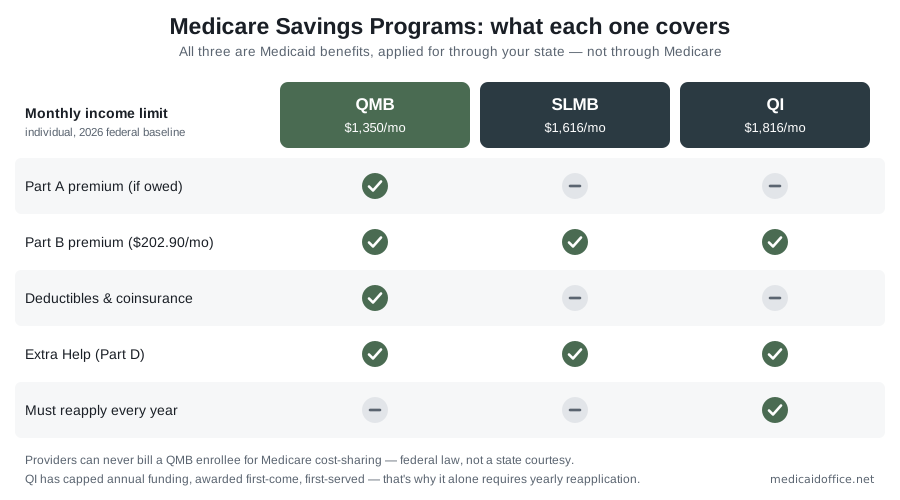
- QMB — the most comprehensive: Part A and Part B premiums, plus all Medicare deductibles, coinsurance, and copayments
- SLMB (Specified Low-Income Medicare Beneficiary) — pays the Part B premium only; requires having both Part A and Part B
- QI (Qualifying Individual) — also pays the Part B premium only, but funding is capped annually and approved first-come, first-served; you must reapply every year
- QDWI (Qualified Disabled & Working Individual) — for people under 65 who lost premium-free Part A and SSDI because they returned to work; pays the Part A premium only
All four programs come with Extra Help for prescription drug costs automatically — you don't need to apply for that separately once you're enrolled in any MSP.
QMB Plus: when you qualify for QMB and full Medicaid
If your income and assets are low enough to qualify for both QMB and full Medicaid benefits, you're considered "dual eligible" — sometimes called QMB Plus. You get QMB's Medicare cost-sharing protections plus your state's full Medicaid benefit package, which can include services Medicare doesn't cover at all, like long-term nursing home care, and in many states routine vision, hearing, and dental care.
Understand how the two programs work together
For a full breakdown of how Medicare and Medicaid coordinate for dual eligibles, see our guide on Medicaid vs. Medicare.
It's illegal for providers to bill QMB enrollees — what to do if you get a bill
Federal law prohibits Medicare providers and suppliers — including pharmacies — from billing QMB enrollees for Medicare cost-sharing. Per CMS, "Medicare beneficiaries enrolled in the QMB group have no legal obligation to pay Part A or Part B deductibles, coinsurance, or copayments for any Medicare-covered items and services." This applies whether or not the provider is actually reimbursed by Medicaid. Despite the law, CMS has found QMB enrollees are still wrongly billed, and confusion about the rule persists among providers.
-
1
Tell the provider you're in the QMB program
Show your Medicare card and your Medicaid or QMB card (or your Medicare Summary Notice) and ask the office to rebill correctly.
-
2
Ask them to check your QMB status directly
Providers can verify QMB enrollment through Medicare's eligibility systems — this removes any doubt without you having to argue the point.
-
3
If the bill continues, call 1-800-MEDICARE
1-800-633-4227 (TTY: 1-877-486-2048) can confirm your QMB status and flag the billing issue.
-
4
Contact your state Medicaid agency
Your state can also intervene directly with a provider who continues billing incorrectly.
How to apply for QMB
QMB is run entirely by states, not by Medicare — you apply through your state Medicaid agency, the same place you'd apply for regular Medicaid. You can't apply for "QMB" specifically and get turned down for a different MSP instead; when you apply, the state evaluates your income and resources and enrolls you in whichever Medicare Savings Program you qualify for.
If you're not sure where to start, your State Health Insurance Assistance Program (SHIP) offers free, one-on-one help from a counselor who can check your eligibility for QMB and other MSPs at no cost. Reach SHIP at 1-877-839-2675 or through shiphelp.org. Even if your income looks slightly above the federal limits listed above, apply anyway — many states don't count all the same income and assets the federal chart does.
Frequently asked questions about the QMB program
What is a QMB card?
It's proof that you're enrolled in the Qualified Medicare Beneficiary program. Depending on your state, that's either a Medicaid card marked with your QMB status or a separate card your state issues. If you have Original Medicare, your Medicare Summary Notice also documents your QMB enrollment and works as proof of coverage.
How do I replace a lost QMB or Medicaid card?
Contact your state Medicaid agency, not Medicare — card replacement is handled at the state level. Most states allow you to request a replacement online through your Medicaid portal, by phone, or in person at a local office.
Can a doctor bill me if I have QMB?
No. Federal law prohibits Medicare providers from billing QMB enrollees for Medicare deductibles, coinsurance, or copayments — even if the provider isn't reimbursed by Medicaid for the difference. If you get a bill, show your QMB proof and ask the provider to rebill correctly; call 1-800-MEDICARE if the billing continues.
Is QMB the same thing as Medicaid?
No. QMB is a Medicare Savings Program — a limited Medicaid benefit that pays your Medicare premiums and cost-sharing. It doesn't include Medicaid's full benefit package unless you also qualify for full Medicaid, in which case you're considered "QMB Plus."
How much can I earn and still qualify for QMB in 2026?
The federal limit is $1,350/month for an individual and $1,824/month for a married couple, with slightly higher limits in Alaska and Hawaii. Resource limits are $9,950 for an individual and $14,910 for a couple. Many states use different or more generous rules, so it's worth applying even if you're close to these numbers.
States mentioned in this guide
Medicaid rules vary by state
Find your state's specific income limits, application steps, and covered benefits.
Related guides
Medicaid vs. Medicare
How the two programs differ — and when you might qualify for both.
Read more →Medicaid & Social Security
How Social Security benefits and Medicaid eligibility interact.
Read more →Eligibility Requirements
The income, household, age, and state rules that determine who qualifies.
Read more →Income Limits
Current income cutoffs by state and household size, tied to the Federal Poverty Level.
Read more →